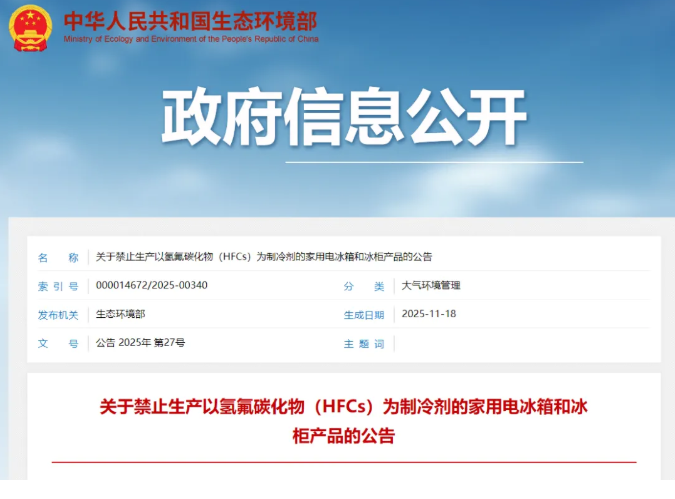
Recently, the Ministry of Ecology and Environment officially issued the "Announcement on Prohibiting the Production of Polyurethane Products Using 1,1-Dichloro-1-fluoroethane (HCFC-141b) as a Foaming Agent" and the "Announcement on Prohibiting the Production of Household Refrigerators and Freezer Products Using Hydrofluorocarbons (HFCs) as Refrigerants." The announcements clearly stipulate that from January 1, 2026, the production of household refrigerators and freezers using HFCs as refrigerants will be prohibited, including those for export, excluding car refrigerators. For the polyurethane foam industry, starting from July 1, 2026, sub-sectors such as refrigerators and freezers, refrigerated containers, electric water heaters, as well as insulated pipelines and solar water heaters, will be prohibited from producing products using HCFC-141b as a foaming agent.
Regarding these two announcements, relevant officials from the Department of Atmospheric Environment of the Ministry of Ecology and Environment provided further interpretation. According to the interpretation, the issuance of these announcements is a proactive measure to advance the phase-out of ODS and the reduction process of HFCs, achieve national compliance goals, and is of significant importance for promoting green, low-carbon, and high-quality development in related industries. It also demonstrates China's responsible attitude in earnestly fulfilling international environmental conventions.
It is understood that China is a major producer of household refrigerators and freezers. Since China accepted the Kigali Amendment, which controls HFCs, in 2021, the country has begun to regulate HFCs and initiated HFC reduction actions. Currently, the domestic refrigerator and freezer industry chain primarily uses the low-carbon and environmentally friendly natural working substance isobutane as a refrigerant. Only a small portion of exported products still use HFCs as refrigerants. Additionally, the polyurethane foam industry is one of the main consumption sectors for HCFCs, including the use of HCFC-141b as a foaming agent to produce insulation foam boards and other polyurethane products.
However, significant progress has already been made in China regarding the production of products using HCFC-141b as a foaming agent. Extensive alternative technology promotion efforts have been carried out, with multiple mature alternatives available across various sub-sectors. Considerable experience has been accumulated in alternative transformation and phase-out. Relevant industry chain enterprises can choose suitable alternatives based on product performance requirements and economic capacity.
Furthermore, isobutane has been successfully used as a refrigerant in household refrigerators and freezers for many years. The technology is mature, the industry chain is well-supported, and the penetration rate exceeds 90%. Additionally, isobutane is a by-product of the petrochemical industry, making it more cost-effective than HFCs and offering clear comprehensive economic benefits.
Currently, the timeline for phasing out products in the main consumption sectors of HFCs and HCFCs is approaching. Moreover, under the national industrial strategy and firm commitment to green development, China's 15th Five-Year Plan is expected to set more specific and stringent phased tasks for the "dual carbon" goals. This means that societal requirements for greenhouse gas emission reduction will transition from "slogans" to the "deep-water zone," and the control of high-GWP (Global Warming Potential) substances will become stricter. This will significantly accelerate the research, development, application, and marketization of the fourth generation of low-carbon and environmentally friendly refrigerants (such as HFOs), potentially bringing major benefits to related enterprises.

 CN
CN
 Sign In


